Your customers want to do their own research — and they also want to call a sales rep before they buy. They want digital speed and human reassurance, often at the same point in the journey. Getting that balance right is one of the harder CX challenges in B2B right now.
The data makes this tension plain:
- 82% of B2B buyers want to self-serve part or all of their buying journey — yet 69% still turn to sales reps for validation before they buy. (Demand Gen Report)
- 67% of buyers prefer a rep-free experience for the research phase — but 69% still want to validate AI-generated insights with a sales rep at key decision points.
Buyers want digital convenience and human reassurance. The question is knowing when to offer which.
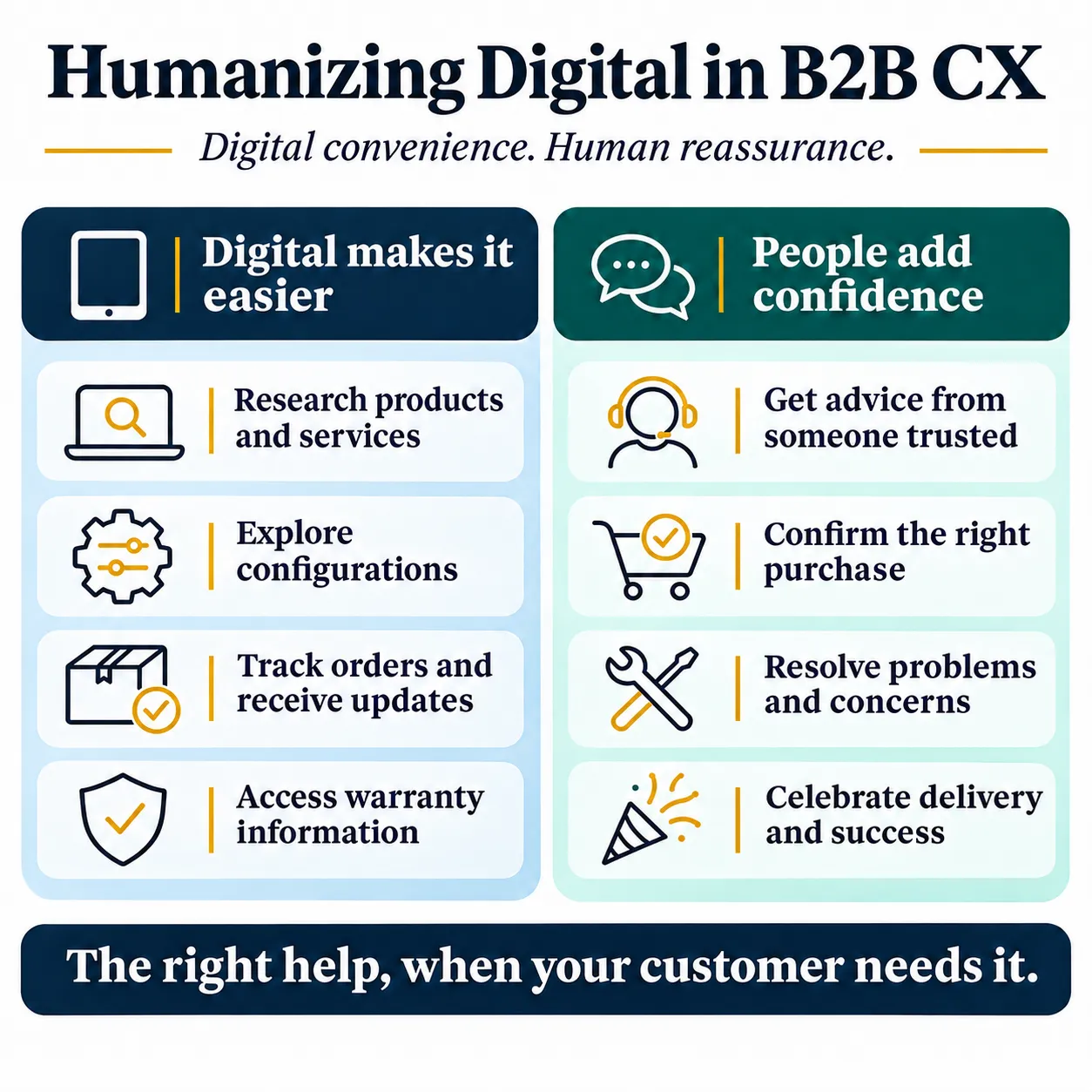
When Customers Want Digital
Digital does several things better than any human interaction can:
Information gathering. Customers want to learn about products and services on their own terms, without worrying about a sales call before they’re ready. This is one reason why websites matter so much today. They must be clear, concise, informative, and easy to use — because that’s where the buying process now starts.
Initial product configuration. Auto dealers discovered this years ago. The ability to configure a product or service and determine whether it fits a customer’s requirements is now expected on most websites. It makes the information-gathering process far more effective.
Communication after the order is placed. This is a significant digital opportunity. Customers want answers to two fundamental questions: Will the product be delivered on time and as configured? Are there any changes they need to know about? Digital handles this broad range of communication needs well — from order status to warranty information.
When Customers Still Want a Human
Yes, customers still want human involvement — just at different points than in the past. Gartner predicted in 2025 that by 2030, 75% of B2B buyers will prefer sales experiences that prioritize human interaction over AI. That shift is already underway.
Where do humans add value that technology cannot replace?
Early interest, before much research is done. Customers at this stage often turn to trusted advisors — colleagues, peers, people they already respect — for their observations about a provider or product. Our research shows that about a third of customers we interview give referrals, and nearly all of those referrals come from highly satisfied customers. Great CX shapes what these influencers say. That’s a powerful reason to invest in service delivery.
When the order is ready to be placed. Customers want to review the details with a human — to make sure everything is included, nothing is missing, and the product or service is really what they need. This is a reassurance task that digital tools, including AI, are poorly suited for.
When something goes wrong during delivery. A delivery date slips. Something was left off the order. These are the moments where technology cannot calm an anxious customer. A human who knows the situation and can communicate clearly is irreplaceable here.
At the end, when there’s something to celebrate. When a new piece of equipment arrives and the customer is genuinely excited — that moment calls for a human. Only a person can share in it.
Getting the Balance Right
Do not assume a digital solution is always the best solution. A few principles worth keeping in mind:
-
Listen to your customers. How do they want things handled? When do they want technology, and when do they want a person? Not all customers want the same thing, and the answer may shift depending on the stage of the relationship.
-
Recognize the influences you don’t control. Customers interact with people who shape their decisions — a Google review, a colleague’s recommendation, an industry peer. You can’t control those conversations directly. What you can control is the quality of experience that prompts customers to recommend you in the first place.
-
Don’t underestimate empathy. A recent study from Zurich Insurance found that 84% of respondents felt empathy was important for a company to provide — yet only 69% thought companies were actually delivering it. About 73% of respondents also said AI cannot show empathy. As more of the customer journey moves to digital channels, the human moments that remain become more important, not less.
The companies that get this balance right aren’t choosing between digital and human. They’re designing for both — giving customers self-service where it serves them, and genuine human connection where it matters most.
What does that balance look like in your company? Drop Lynn a line at lynndaniel@thedanielgroup.com — we’d like to hear how you’re navigating it.
Frequently Asked Questions
- Do B2B buyers prefer digital self-service or human interaction?
- B2B buyers want both, depending on the stage of the buying journey. Research shows that 82% of B2B buyers want to self-serve part or all of their buying process, yet 69% still turn to sales reps for validation before they buy. Buyers prefer digital tools for independent research and information gathering, but consistently want human involvement at key decision points — particularly when placing an order, resolving a problem, or seeking reassurance about a major purchase.
- At what stages of the B2B buying journey do customers want human contact?
- B2B customers most consistently want human contact at four points: early in the process when they're seeking input from trusted advisors and peers before researching on their own; at the moment of placing an order, when they want a human to confirm all details are correct; when something goes wrong during delivery and technology cannot resolve the concern; and at the end of a successful transaction, when there is something to celebrate. These are moments where digital tools and AI are poorly suited to provide the reassurance, accountability, or connection that customers need.
- How do you balance digital and human touchpoints in B2B customer experience?
- Balancing digital and human touchpoints in B2B CX starts with listening to customers about how they want to be served at each stage — because preferences vary by customer and by stage. As a general rule, digital works best for information gathering, product configuration, and post-order communication. Human involvement matters most at decision points, when issues arise, and when there is something worth celebrating with the customer. The mistake most B2B companies make is defaulting to digital to reduce cost without asking where human contact actually drives loyalty.
- Why is empathy still important in B2B customer experience as companies go digital?
- Empathy remains important in B2B because customers increasingly notice when it is absent. A Zurich Insurance study found that 84% of respondents considered empathy important for companies to demonstrate, but only 69% felt companies were actually delivering it — and 73% said AI cannot show empathy. As more of the customer journey moves to digital channels, the human moments that remain carry more weight, not less. Companies that maintain genuine human connection at critical touchpoints differentiate themselves precisely because it has become harder to find.
- What role do customer referrals play in B2B digital CX strategy?
- Customer referrals are a significant part of B2B growth — and they are driven almost entirely by the quality of the human experience, not the digital one. Research from The Daniel Group shows that roughly one-third of B2B customers interviewed give referrals, and nearly all of those referrals come from highly satisfied customers. Because buyers in the early stages of a purchase often turn to trusted advisors and peers for input before they begin their own research, the experience you deliver shapes what those influencers say. Great CX is one of the few levers a B2B company has over those early conversations.
Customer Feedback Programs
Full-service customer feedback programs built for B2B industrial companies.
Learn More →